
How Jumbo Loans Work for Luxury Properties in Sammamish and Beyond
If you're shopping for a lake-view home on the Plateau or a new-build in Issaquah Highlands, you'll run into jumbo loans Washington state buyers use every day. Most Eastside luxury listings sail right past standard conforming limits, which means you need a different playbook for financing, qualifying, and closing.
I've watched this market up close for years, and here's the truth: jumbo isn't scary, it's just more manual. More documentation, more reserves, more attention to appraisal — but also more flexibility if you work with a lender who knows portfolio guidelines.
Key Takeaways
What you need to know before you tour that $1.8M Sammamish colonial:
| Topic | What to Know for Sammamish / Eastside |
|---|---|
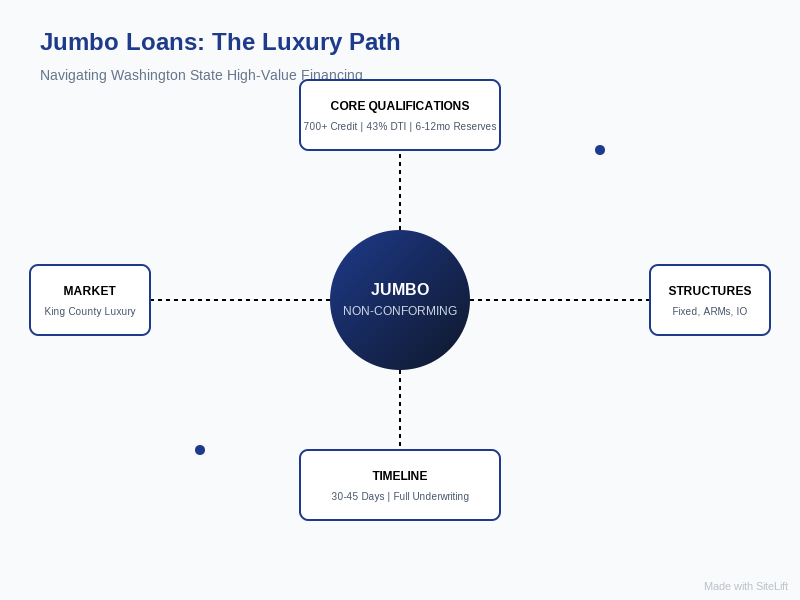
| When you need jumbo | Loan amount above FHFA conforming limit for King County; most $1.2M+ purchases with 10-20% down |
| High-balance vs. jumbo | High-balance is still conforming and sold to Fannie/Freddie; jumbo is non-conforming, portfolio-held |
| Core qualifications | 700-740+ credit, 38-43% DTI, full income docs, 6-12 months reserves |
| Best loan structures | 30-yr fixed, 7/6 and 10/6 ARMs, interest-only, construction-to-permanent, bridge loans |
| Timeline | 30-45 days typical; fully underwritten pre-approval wins in multiple-offer situations |
What Are Jumbo Loans Washington State Luxury Buyers Need to Understand?
A jumbo loan is simply a mortgage that exceeds the conforming loan limit set by the Federal Housing Finance Agency (FHFA). Because it can't be sold to Fannie Mae or Freddie Mac, the lender holds more of the risk — and underwrites accordingly.
That difference drives everything:
- No GSE backing: No automated Fannie/Freddie approval. A human underwriter reviews income, assets, and property in detail.
- Stricter documentation: Expect two years of tax returns, W-2s or 1099s, two months of bank and investment statements, and a clear paper trail for large deposits.
- Reserve requirements: Jumbo lenders want to see you can still pay after closing, often 6-12 months of payments in reserve.
- Pricing is risk-based: Rates can be surprisingly competitive, but pricing adjusts more sharply for credit score, loan-to-value, and property type.
Jumbo vs. Conforming vs. High-Balance Loans in Washington State
Think of it in three buckets:
- Conforming: At or below the FHFA baseline limit. According to the Federal Housing Finance Agency, the baseline conforming loan limit for a single-unit home in 2027 is $855,400. You can explore current figures with the FHFA conforming loan limits data tool.
- High-balance conforming: Above baseline but still within the high-cost area ceiling for counties like King, Snohomish, and Pierce. These loans still follow Fannie Mae loan limit guidance and can be sold to the agencies.
- Jumbo: Above that high-cost ceiling. True portfolio loans with lender-specific rules.
For more background on conforming standards, Fannie Mae publishes its selling requirements and eligibility rules for lenders and borrowers.
Why Luxury Home Financing in Sammamish, Issaquah, and Bellevue Often Requires Jumbo
On the Eastside, jumbo isn't just for mansions. According to Redfin housing market data, the median sale price in Sammamish consistently exceeds $1.3 million, which pushes even a standard 4-bedroom with 20% down into jumbo territory.
Add in what makes this area desirable — larger lots on the Plateau, new construction in Talus and Snoqualmie Ridge, view properties above Lake Sammamish, and high-end townhomes in downtown Bellevue — and appraised values climb fast. If you're exploring luxury home financing Issaquah buyers use for $1.4M to $2.5M properties, assume jumbo until a lender proves otherwise.
If you're just starting your search, start with a local strategy on Buy a Home in Washington State | Get Pre-Approved to map your budget before you fall in love with a home.
What Are the Current Jumbo Loan Limits and High Balance Loan Limits in WA?
FHFA resets limits every fall based on home price changes. The baseline applies nationwide, but high-cost counties get a higher ceiling — typically 150% of baseline.
King, Snohomish, and Pierce counties are designated high-cost because median values are so far above the national average. Most other Washington counties use the $855,400 baseline for 2025.
Pro Tip: Don't shop by purchase price alone. Shop by loan amount. A $1,350,000 purchase with 20% down is a $1,080,000 loan — likely jumbo in King County. That same price with 35% down could stay high-balance conforming.
When Does a High-Balance Loan Become a Jumbo Loan?
The line is simple: one dollar over the high-cost conforming ceiling for that county and property type, and you're in jumbo.
Why it matters:
- High-balance conforming still gets GSE pricing and automated underwriting.
- Jumbo gets portfolio pricing, manual review, and often a second appraisal.
- Loan-level price adjustments, mortgage insurance rules, and condo requirements all change at that line.
That's why high balance loan limits WA buyers search for can be confusing. Your lender has to check county, units, and loan purpose every time.
 ### Loan Amount Examples for Luxury Properties in Sammamish and Beyond
| Purchase Price | Down Payment | Loan Amount | Likely Category in King County |
|---|---|---|---|
| $1,200,000 | 20% ($240k) | $960,000 | High-balance or jumbo depending on year limit |
| $1,800,000 | 20% ($360k) | $1,440,000 | Jumbo |
| $1,800,000 | 10% ($180k) | $1,620,000 | Jumbo with PMI / lender-specific 10% down jumbo |
| $2,500,000 | 25% ($625k) | $1,875,000 | Jumbo |
New construction adds another wrinkle. Lot value + build cost often pushes the final loan well above initial estimates.
What Are the Jumbo Mortgage Requirements to Qualify in Washington?
Jumbo mortgage requirements are stricter, but they're predictable. Lenders want to see stability, liquidity, and a property that supports the value.
Credit Score, Income, and Debt-to-Income Standards
- Credit: Most portfolio lenders want 700-740+ for best pricing, with no recent late payments. According to Experian, borrowers generally need good to excellent credit to secure the best mortgage terms, and jumbo is no exception.
- DTI: 38-43% maximum in most cases, including housing, car payments, student loans, and minimum card payments. Some lenders allow up to 45% with strong reserves.
- Income: Full documentation is standard. Salaried borrowers provide paystubs and W-2s. Tech buyers with RSUs, bonuses, or stock options need a two-year history and vesting schedule to count that income.
Self-employed? Expect two years of personal and business returns, plus a profit-and-loss statement. Bank-statement jumbo options exist but price higher.
Down Payment, Cash Reserves, and Asset Documentation
- Down payment: 10-20%+ is typical. 10% down jumbo exists but usually requires 740+ credit, low DTI, and significant reserves.
- Reserves: 6-12 months of total housing payments left in checking, savings, or investments after closing. On a $8,500 payment, that's $51,000 to $102,000.
- Gift funds: Allowed by many jumbo lenders for primary homes, but must be documented with gift letter and transfer trail. They rarely count as reserves.
- Large deposits: Anything outside payroll needs an explanation. Move money early and keep it seasoned.
Pro Tip: Keep your down payment, closing costs, and reserves in one place for 60 days before you apply. Underwriters love boring bank statements.
Property Appraisal and Eligible Property Types
Luxury appraisals take longer. Unique floor plans, acreage, lake frontage, and custom finishes mean fewer comps.
- Single-family homes are easiest to finance.
- Luxury condos need warrantable status, healthy HOA budgets, and adequate owner-occupancy.
- Second homes are widely allowed; investment properties face higher down payments and rates.
- Many lenders require a second appraisal or field review above $1.5M-$2M loan amounts.
For Plateau specifics, my page as a Sammamish Mortgage Lender | Home Loans in Sammamish, WA breaks down new construction and jumbo considerations lot by lot.
 Infographic by SiteLift
How Does Luxury Home Financing Work in Sammamish, Issaquah, and the Eastside?
Financing here is competitive. Sellers often review 3-5 offers, many with large down payments or quick closes. Your loan structure can be as important as your price.
Jumbo Loan Options: Fixed-Rate, ARM, Interest-Only, and Bridge Loans
- 30-year fixed jumbo: Predictability for long-term owners. Best if you plan to stay 7+ years.
- 5/6, 7/6, 10/6 ARMs: Fixed for 5, 7, or 10 years, then adjusts every 6 months. Eastside move-up buyers love 7/6 ARMs for lower initial payments.
- Interest-only jumbo: Pay interest only for 7-10 years. Useful for executives with variable comp or business owners managing cash flow — if you understand the reset risk.
- Construction-to-permanent jumbo: One close for lot + build, converting to permanent financing. Critical for Sammamish and Snoqualmie Ridge builds.
- Bridge loans: Buy before you sell without a contingent offer. This is huge when you have $600k in equity trapped in your current home.
If you need to move first and sell second, check out Buy Before Selling in Washington | The Bridge Loan Specialist | Troy Gamble. It's built exactly for Eastside move-up buyers.
How Jumbo Rates and Closing Costs Compare to Conventional Loans
Are jumbo rates higher? Sometimes, but not always. According to the Mortgage Bankers Association, jumbo products represent a significant share of purchase originations in high-cost coastal markets like Seattle-Bellevue, which keeps competition among portfolio lenders healthy. You can follow national trends in Mortgage Bankers Association research and economics.
In practice:
- Well-qualified jumbo borrowers often see rates within 0.125% to 0.375% of conforming.
- ARMs typically price 0.5% to 1% below 30-year fixed jumbo.
- Closing costs run higher due to two appraisals, jumbo underwriting fees, and higher prepaid taxes and insurance on expensive homes.
- Review every fee on page 2 of your Loan Estimate. The Consumer Financial Protection Bureau has a helpful guide to understanding your Loan Estimate that I send to all my buyers.
Financing Strategies for Move-Up Buyers, New Construction, and High-End Condos
For luxury home financing Issaquah families often juggle a sale in Klahanie or the Highlands plus a purchase in Sammamish:
- Get fully underwritten before you list — not just pre-qualified.
- Use bridge financing to make a non-contingent offer, then pay down the jumbo after your sale.
- For new construction, lock your long-term strategy early. Builders' preferred lenders aren't always cheapest on jumbo ARMs.
- For condos, have your lender review the HOA budget and insurance upfront. Nothing kills a luxury condo closing faster than a non-warrantable project.
My neighbors in Issaquah can find neighborhood-specific help on my Issaquah Mortgage Lender | Home Loans in Issaquah, WA page — I live here and close these loans weekly.
How Do Jumbo Loans Washington State Borrowers Choose Close From Pre-Approval to Funding?
The process is familiar, just more thorough. Here's how it flows when done right:
- Discovery call: Purchase price, down payment source, income type, timeline, property type.
- Full application + docs: Paystubs, W-2s, tax returns, asset statements, ID, HOA docs if condo.
- Fully underwritten pre-approval: Underwriter reviews credit, income, and assets before you offer. This beats a basic pre-qual letter in multiple offers.
- Offer + locked rate: Once under contract, lock rate and choose fixed vs. ARM.
- Appraisal + second review: 2-3 weeks for luxury properties. Appraiser needs comps for view, lot size, and quality.
- Conditions + final approval: Expect questions about transfers, business income, or HOA litigation.
- Closing disclosure + funding: Three-day review period, then signing and wire. Jumbo wires are large — verify instructions by phone.
Plan 30-45 days from contract to keys. Rushing a jumbo in 21 days is possible with a clean file, but appraisal often sets the pace.
My Take: Why Eastside Jumbo Loans Reward Local Strategy
I'll be blunt: national call centers struggle with Eastside jumbo files.
I recently talked with a couple moving from Redmond to Sammamish — both in tech, great credit, one with RSUs making up a third of income, plus a home to sell. An online lender pre-approved them in 15 minutes based on base salary alone. When underwriting actually counted RSU history and found their current home listed as contingent, the approval fell apart a week before closing.
We rebuilt it locally: used a 7/6 ARM with RSU income properly documented, set up a bridge to make their offer non-contingent, and ordered the second appraisal day one because we knew the loan amount would trigger it. They closed only six days late, but they closed.
That's my bias after 28 years in Washington lending: jumbo is a relationship loan. Portfolio guidelines change by lender, appraisers need local context for that $2M view premium, and listing agents in Sammamish and Issaquah do call the lender. When they hear a local direct number instead of an 800 number, your offer gets more weight.
If your income is straightforward and your property is cookie-cutter, any lender can do it. If you have stock comp, self-employment income, new construction, or a buy-before-you-sell puzzle — go local. You'll feel the difference in week three when underwriting gets picky.
Ready to Talk Through Your Jumbo Scenario?
You don't need to guess whether you need high-balance or jumbo, fixed or ARM, or how much reserve is enough. Bring me your purchase price, down payment, and timeline, and I'll map two or three clear options with total monthly cost — not just rate.
At troygamble.com, you work directly with me, not a call center. No handoffs, no disappearing loan officer, just straight answers from someone who closes jumbo loans Washington state families rely on in Bellevue, Sammamish, Issaquah, and Snoqualmie every month.
 > — troygamble.com
FAQ About Jumbo Loans in Washington State
What is the jumbo loan limit in Washington state for 2025-2026?
For 2027, the FHFA baseline is $855,400 for a single-unit home, with higher ceilings in high-cost counties like King, Snohomish, and Pierce. If your loan amount is above your county's conforming ceiling, you need a jumbo loan. Limits reset annually, so confirm your county and loan year before you offer.
What credit score and down payment do I need for a jumbo loan in Washington?
Most lenders want 700-740+ credit and 10-20% down. The strongest pricing usually goes to 740+ credit with 20% down and 12 months reserves. With 10% down, expect tighter DTI caps, higher reserves, and excellent credit history.
Are jumbo loan rates higher than conventional rates in Washington?
Often slightly higher, but the gap is usually small for well-qualified borrowers. ARMs often price below 30-year fixed jumbo. Your credit, loan-to-value, property type, and reserves move your rate more than the label “jumbo” itself.
Can I get a jumbo loan for a second home or investment property in Sammamish or Issaquah?
Yes for second homes — many Eastside buyers finance lake or vacation homes with jumbo. Investment properties are tougher, with larger down payments (often 25-30%), higher rates, and bigger reserve requirements. Condos and new construction get extra review in both cases.
How much cash reserves do I need to qualify for luxury home financing?
Plan on 6-12 months of full housing payments left over after closing. That includes principal, interest, taxes, insurance, and HOA. Lenders can count checking, savings, and 60-70% of vested retirement or brokerage accounts, but they generally don't count gift funds as reserves.

Troy Gamble
Branch Manager & Mortgage Loan Officer · NMLS 40183
Helping Washington buyers navigate their home purchase with confidence.